
Miniature linear guides are widely utilized in small-scale automated equipment, precision instruments, inspection devices, electronic manufacturing machinery, and compact linear slide assemblies. Compared to standard linear guides, miniature linear guides feature a smaller footprint and lighter weight, making them ideal for equipment applications where installation space is limited, travel distances are short, and high precision is required.
1. What are LGN Miniature Linear Guides?
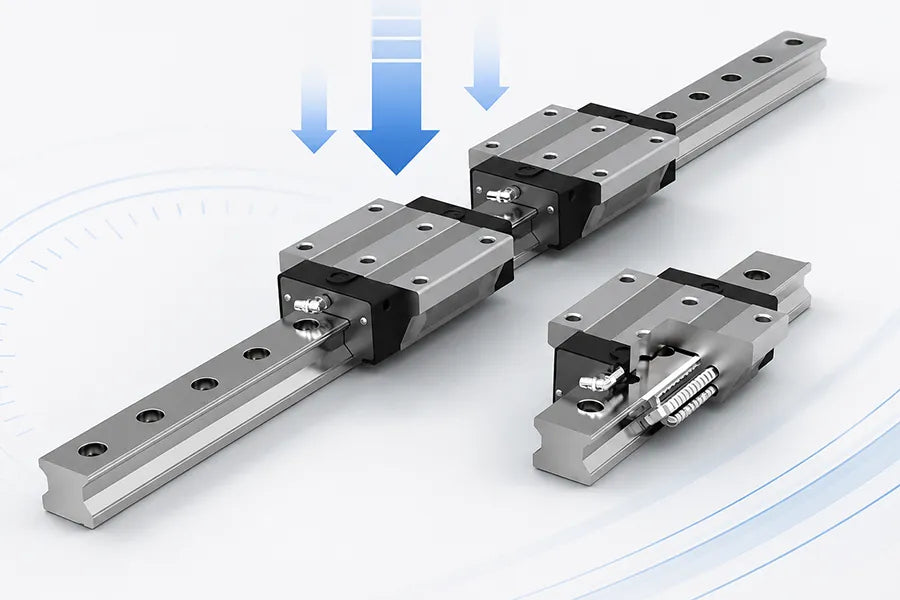
LGN miniature linear guides are characterized by their compact size and lightweight design, making them particularly well-suited for use in miniaturized equipment. Both stainless steel and standard steel options are available for the guide blocks and rails. The stainless steel variant—including the guide block, rail, and other metal components such as steel balls and retainers—is constructed entirely from stainless steel, offering excellent rust-resistant properties. Utilizing a Gothic-arch four-point contact design, these guides can withstand loads from all directions while offering high rigidity and exceptional precision. Additionally, they feature a steel ball retainer design, allowing for interchangeability within specified precision tolerances.
Miniature linear guides are ideal for applications or specific components requiring a small footprint and light weight; they are particularly well-suited for small-scale automated equipment.

2. What are LGW Wide Miniature Linear Guides?
The widened rail design of the LGW series significantly enhances its moment load capacity, enabling effective operation as a single-rail system. Employing a Gothic-arch four-point contact design, it can withstand loads from various directions and is characterized by its high rigidity. The guide block is equipped with a miniature steel ball retainer wire, ensuring that the steel balls remain securely in place even when the guide block is removed from the rail.
The wide design of the LGW miniature linear guide makes it suitable for equipment applications that require the capacity to bear loads from multiple directions or are designed to operate using a single linear guide rail.

3. Key Differences Between LGN and LGW
Within the category of miniature linear guides, LGN and LGW represent two common structural configurations. While both belong to the miniature linear guide series, they differ in several key aspects:
3.1 Structural Width
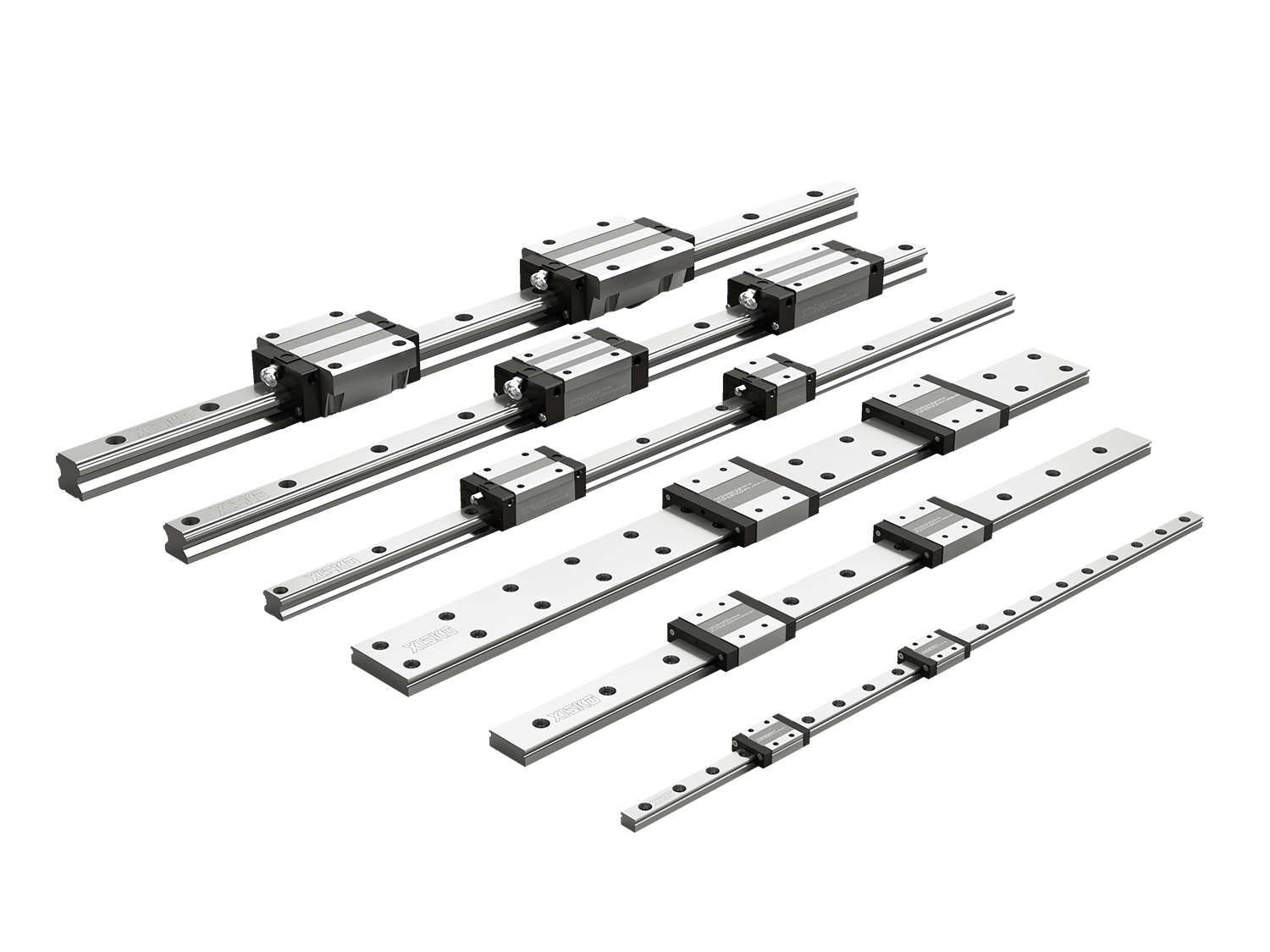
The LGN series features a more standard, compact structure, making it suitable for parallel dual-rail installations or light-load precision motion applications. Conversely, the LGW series features a widened structure; this design provides superior resistance to moment loads, making it better suited for single-rail applications or scenarios where higher stability is required.
3.2 Load Direction and Moment Load Capacity
Miniature linear guides are required to withstand not only vertical loads but also potential lateral forces, eccentric loads, and overturning moments. Particularly during single-rail installation, the forces acting on the slider are often not purely vertical; instead, they frequently involve eccentric loading.
The LGN performs well under light loads and uniform force distribution; however, when faced with significant eccentric loads, its stability is inferior to that of wide-profile guide rails.
The primary advantage of the LGW lies in its superior resistance to moments. Its wide-profile structure is better equipped to withstand overturning moments acting around the guide rail's axis; consequently, it is more commonly utilized in single-rail linear stages, single-axis motion platforms, and compact linear modules. As noted in AST Bearings' product description for their miniature wide-profile series, the wide-profile type is capable of supporting larger axial moment loads and is well-suited for single-rail guide arrangements.
3.3 Differences in Mounting Configurations
Common mounting configurations for the LGN include:
- Parallel dual-rail arrangements;
- Single-rail arrangements with dual sliders;
- Assemblies of multiple small linear stages;
- Light-load linear guidance structures.
Common mounting configurations for the LGW include:
- Single-rail arrangements with a single slider;
- Single-rail arrangements with dual sliders;
- Wide-profile single-axis linear stages;
- Structures where installation space is limited but high stability is required.
When designing equipment, if the goal is to minimize slider oscillation during motion—and a dual-rail configuration is not feasible—the structural advantages of the LGW become particularly pronounced.
3.4 Differences in Spatial Footprint
The LGN features a narrower lateral profile, making it ideal for installation within equipment where space is at a premium. Examples include small inspection fixtures, precision adjustment mechanisms, electronic assembly equipment, and compact mechanisms within 3D printers.
Although the LGW also falls under the category of miniature guide rails, its lateral profile is wider, thereby requiring a larger installation width. However, it can, to a certain extent, eliminate the need for a dual-rail structure. In other words, in certain designs, utilizing a single LGW rail may result in greater overall space savings and lower installation costs compared to utilizing two LGN rails.
Therefore, one cannot simply assume that the LGN is invariably more space-efficient, nor that the LGW invariably occupies more space. The critical factor is whether the equipment design employs a single-rail or a dual-rail structure.
4. Which Applications Are Suitable for the LGN and LGW?
Four Key Scenarios Where Wide-Rail Guides Are Preferred:
- High-frequency impact loads: e.g., transmission mechanisms in stamping equipment.
- Long-span cantilever structures: e.g., robotic arms exceeding 500mm in length.
- Compound moment conditions: e.g., spindles in multi-axis linkage machine tools.
- High rigidity requirements: e.g., Z-axis positioning in laser cutting machines.
LGN standard miniature linear guides are suitable for the following applications:
- Small-scale automation equipment;
- Electronic inspection equipment;
- Small XY stages;
- Internal sliding mechanisms in medical instruments.
These applications typically share a common set of characteristics: light loads, limited space, and short travel distances—yet they require a certain level of smoothness and positioning accuracy.
5. How to Choose Between LGN and LGW?
LGN is suitable for precision motion applications involving light loads, minimal eccentric loading, and compact spatial constraints. Provided the structural design is sound and installation precision is high, LGN can deliver exceptionally smooth motion performance.
The primary advantage of LGW lies in its superior motion stability—particularly when the center of the load is offset from the guide rail's centerline. Its wide-profile structure effectively minimizes slider wobble, resulting in smoother overall motion.
For small-scale automation equipment requiring high repeatability in positioning, minimal oscillation, and low vibration, LGW typically offers a distinct advantage.
6. General Selection Recommendations
If your equipment is a small-scale inspection instrument with a very light load, requiring only short-stroke reciprocating motion from the slider, LGN is a perfectly adequate choice.
If your equipment is a single-axis linear stage—where the slider is fitted with fixtures, sensors, small actuators, or camera modules—and the center of the load does not sit directly above the guide rail, LGW is the recommended choice.
If your structural design already incorporates a pair of parallel guide rails, and the precision of the mounting reference surfaces is high, a dual-rail LGN configuration can satisfy the majority of light-load precision motion requirements.
However, if you wish to simplify the structural design—thereby reducing the complexity of aligning the parallelism between two rails—while simultaneously maintaining excellent motion stability, LGW represents the more suitable choice.
If the equipment is intended for long-term continuous operation, and the working environment presents potential risks regarding humidity or corrosion, you should prioritize factors such as the guide rail's material composition, anti-corrosion properties, lubrication method, and sealing structure. Simkawa's LGW product page notes that its sliders and metal accessories are constructed from stainless steel, offering inherent advantages in corrosion resistance.
Conclusion
Both LGN and LGW fall under the category of miniature linear guide rails, yet they cater to distinct application priorities. LGN is best suited for precision motion scenarios emphasizing miniaturization, lightweight design, and minimal eccentric loading; conversely, LGW is the preferred choice for compact equipment applications that demand superior stability, greater resistance to moment loads, and suitability for single-rail configurations.