
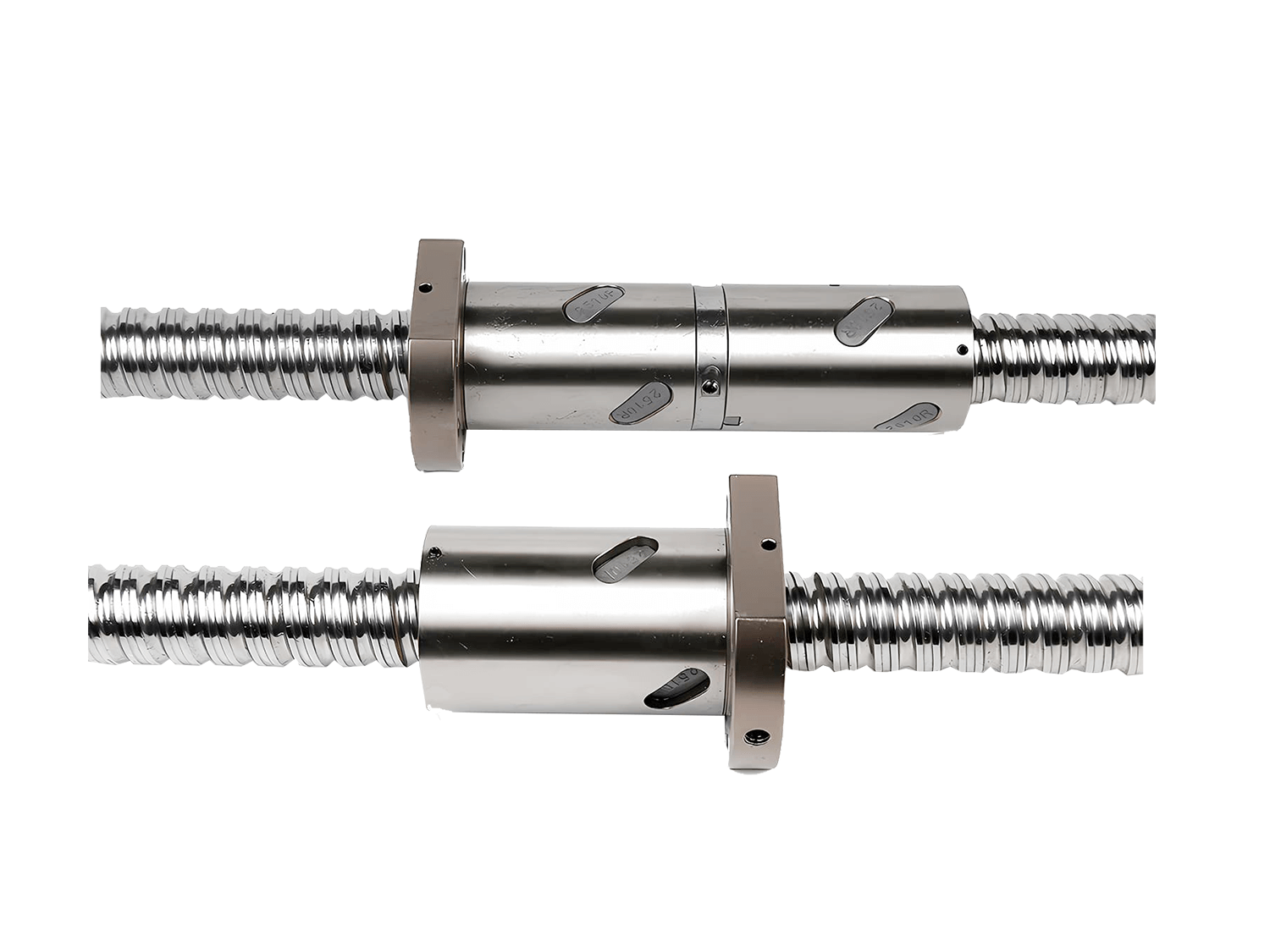

Grinding and rolling are the two primary manufacturing methods for ball screws. Users familiar with ball screw products are likely well aware that differences in processing techniques and manufacturing methods result in distinct characteristics in the finished products. The following content provides a detailed comparison of ground ball screws versus rolled ball screws, examining the differences from several key perspectives:
1. Differences in Manufacturing Methods
1.1 Ground Ball Screw
Building upon the rolled base, this process utilizes specialized cylindrical grinding machines to perform precision machining on the arc-shaped grooves, refining their dimensions and profiles. In this method, the actual cutting takes place at the bottom of the arc-shaped grooves. The resulting accuracy level is moderate to high, making it suitable for equipment with stringent precision requirements, such as CNC machine tools.
1.2 Rolled Ball Screw
This process begins by cutting grooves of a specific depth into a smooth shaft blank. The spacing between these grooves corresponds to the desired screw pitch. The threads are then formed by rolling the shaft using a thread-rolling machine—a process similar to standard screw thread manufacturing. The resulting accuracy level is generally moderate to low, making it suitable for use in general-purpose equipment where high precision is not a critical requirement.
1.3 Distinction
Rolled ball screws are formed through an extrusion-rolling process, whereas ground ball screws—as the name implies—are produced via a grinding process. Since the rolling and grinding processes differ fundamentally, the finished products naturally exhibit distinct surface characteristics and processing marks.
2. Differences in Processing Techniques
2.1 Ground Ball Screws
Ground ball screws utilize a precision grinding process, wherein the screw threads are progressively refined using high-precision CNC grinding machines. This process typically involves the following stages: Cutting → Fine Grinding → Dressing.
Characteristics
High precision and excellent surface quality; however, manufacturing efficiency is relatively low, and production costs are high.
2.2 Rolled Ball Screws
Rolled ball screws are produced via a cold-rolling process, utilizing dies to extrude and form the metal material into the desired thread profile.
This is a chipless machining process (no material is removed), resulting in a high material utilization rate.
Characteristics
High manufacturing efficiency and low production costs; however, the achievable precision is limited by the accuracy of the rolling dies used.
3. Differences in Appearance and Detail
3.1 Ground Ball Screws
In the ground grade, traces of the grinding wheel are clearly visible upon close inspection of the surface. In terms of physical appearance, the raceway grooves of a rolled-grade ball screw are smooth but relatively shallower compared to those of a ground ball screw; furthermore, the crests between the raceway grooves on a rolled-grade ball screw typically feature a small groove.
3.2 Rolled Ball Screws
Generally, the surface of a rolled ball screw appears smooth and glossy. Under lighting conditions, the surface exhibits high reflectivity, which can result in a dazzling or glaring effect.
4. Differences in Accuracy
The precision of ground ball screws is generally rated at C7 (±50/300 mm) or higher, whereas the precision of rolled ball screws is typically rated at C7 (±50/300 mm) or lower.
| Comparison Dimension | Ground Ball Screw | Rolled Ball Screw |
| Accuracy Grade | C1–C5 | C7–C10 |
| Pitch Error | Minimal | Significant |
| Repeatability | ±0.003 mm | ±0.02 mm or Better |
| Surface Roughness | Lower (Smoother) | Rougher |
| Noise and Vibration | Lower | Relatively High |
| Preload Capability | High (Suitable for high-rigidity systems) | Limited |
| Service Life | Stable and Highly Consistent | Depends on Operating Conditions |
5. Key Selection Factors
In practical project applications, it is recommended to make a determination based on the following five dimensions:
5.1 Accuracy Requirements
≤ 0.01 mm → Prioritize ground ball screws
≥ 0.02 mm → Rolled ball screws may be considered
5.2 Budget Constraints
The price of ground ball screws is typically 2 to 5 times that of rolled ball screws.
For large-volume projects, the rolled option should be prioritized.
5.3 Operating Speed and Load
High Speed + High Load → Ground ball screws recommended (for superior stability)
Medium-to-Low Speed + Moderate Load → Rolled ball screws are sufficient
5.4 System Rigidity Requirements
High-Rigidity Equipment (e.g., CNC machines) → Ground ball screws + Preload structure
General Automation Equipment → Rolled ball screws are sufficient
Summary
The content above provides a detailed introduction to the differences between ground ball screws and rolled ball screws. We are confident that, having reviewed this information, you will be able to clearly distinguish between these two types of ball screw products. If you have any further questions, please feel free to contact us.

