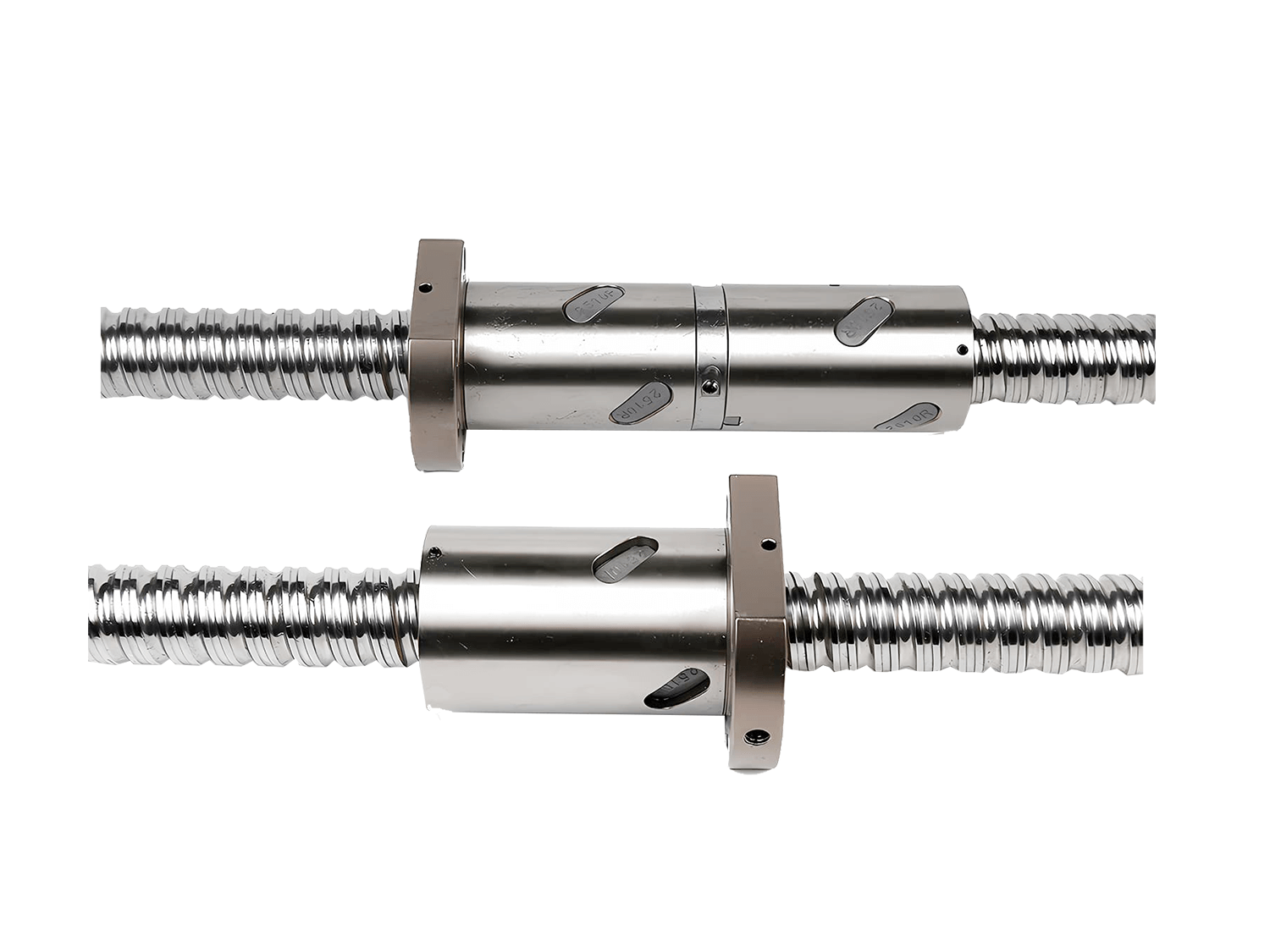

In modern automated machinery, ball screws are widely used in CNC machine tools, industrial robots, and precision testing equipment due to their high efficiency, low friction, and high precision. However, to fully utilize the performance of ball screws, accurate calculation of their mechanical parameters and motion characteristics is crucial. Today, we'll discuss how to select a suitable servo motor to drive a ball screw based on actual needs. This process is not complicated, but it requires some basic calculations.
1. Basic Ball Screw Parameter Analysis
Before performing calculations, it's essential to understand the key parameters of a ball screw:
1.1 Lead (Pd)
The distance the nut moves in one revolution of the screw, Pd = v/n (v: linear velocity; n: rotational speed).
1.2 Screw Efficiency (η)
Ball screws have low frictional losses, with an efficiency typically between 85% and 95%. Efficiency must be considered when calculating motor torque and torque to ensure the power system can meet actual load requirements.
1.3 Rated Load
The static and dynamic loads of the ball screw determine its load-bearing capacity and service life. Correct selection should be based on actual load capacity and expected lifespan.
1.4 Nut Type and Preload
Preload nuts can eliminate backlash, improve system rigidity and positioning accuracy, but increase starting friction. Preload must be taken into account when calculating torque.
2. Precise Calculation of Ball Screws
The following is a detailed explanation using a specific example.
2.1 Given Conditions
First, we need to know some basic parameters:
- Total load mass: M = Worktable + Load weight = 20kg;
- Linear velocity: V = 0.3m/s;
- Ball screw lead: Pd = 10mm;
- Guide rail friction coefficient: μ = 0.1;
- Total efficiency: η = 0.8;
- Safety factor: K = 1.5;
- Gravitational acceleration: g = 10m/s².
2.2 Calculating Rotational Speed
The formula for calculating rotational speed is: n = V * 60 * 1000 / Pd
Substituting the given conditions, we get: n = 0.3 * 60 * 1000 / 10 = 1800r/min
2.3 Calculating Inertia and Torque
Next, we need to calculate the load inertia and acceleration torque. The calculation formulas are as follows:
- Inertia calculation formula (ball screw): J = m * (Pd / 2)²;
- Load inertia: J = 20 * 0.00000254 = 0.0000507kg/m²;
- Angular acceleration calculation formula: β = w / t;
- Angular velocity calculation formula: W = 2πn / 60;
- Angular velocity: W = 6.28 * 1800 / 60 = 188.4rad/s;
- Angular acceleration: β = 188.4 / 0.2 = 942rad/s²;
- Accelerating torque calculation formula: T = J * β;
- Accelerating torque: T = 0.0000507 * 942 = 0.048Nm.
2.4 Maximum torque calculation
The maximum torque calculation formula is: (Accelerating torque + Rated torque) * Safety factor / Total efficiency
Substituting the known conditions, we get: (0.048 + 0.032) * 1.5 / 0.8 = 0.15Nm
2.5 Actual Inertia Matching
Finally, we need to confirm whether the actual inertia matches. The actual inertia should be one-third of the load inertia, i.e.: Actual inertia / 3 = 0.0000507 / 3 = 0.0000169kg/m²
2.6 Summary Selection
Based on the above calculations, we can draw the following conclusions:
- Rated Torque: 0.06Nm;
- Maximum Torque: 0.15Nm;
- Inertia Matching: 0.0000169kg/m²;
- Speed Matching: 1800r/min.
Summary
Hopefully, this example will help you and make servo motor selection easier! If you have any questions, please feel free to contact us!