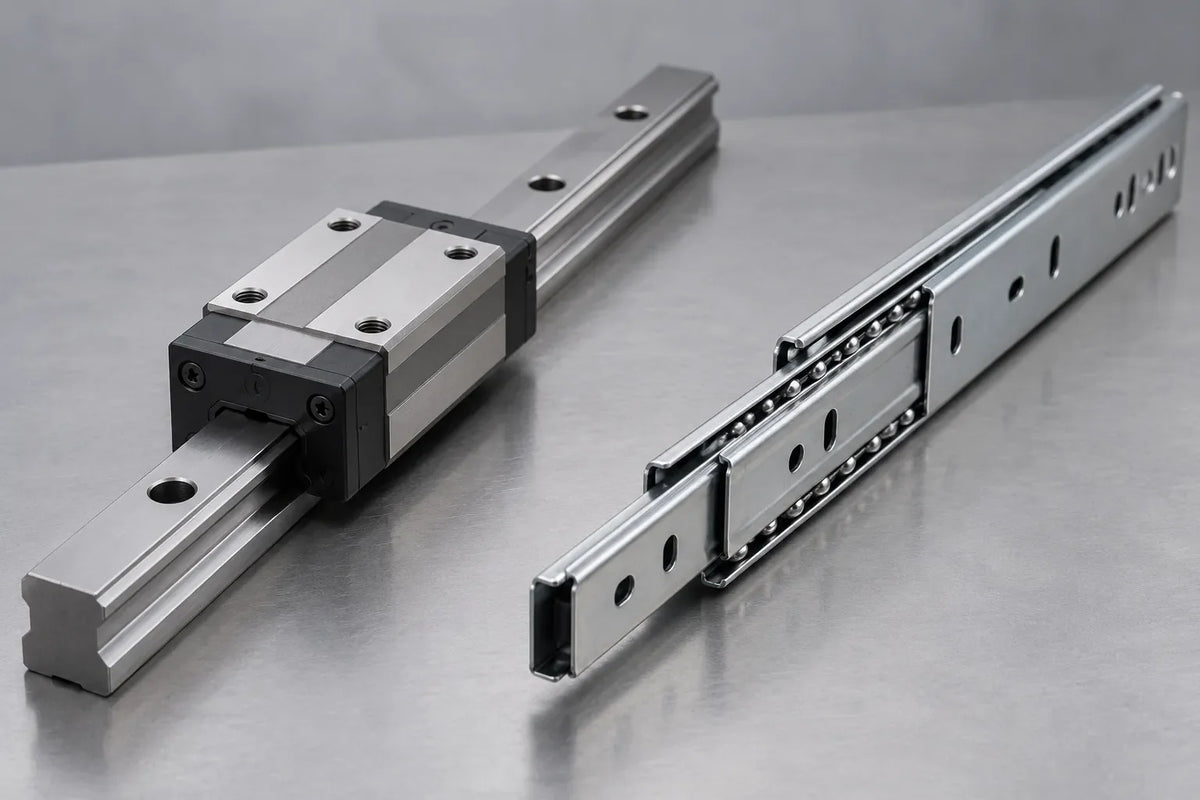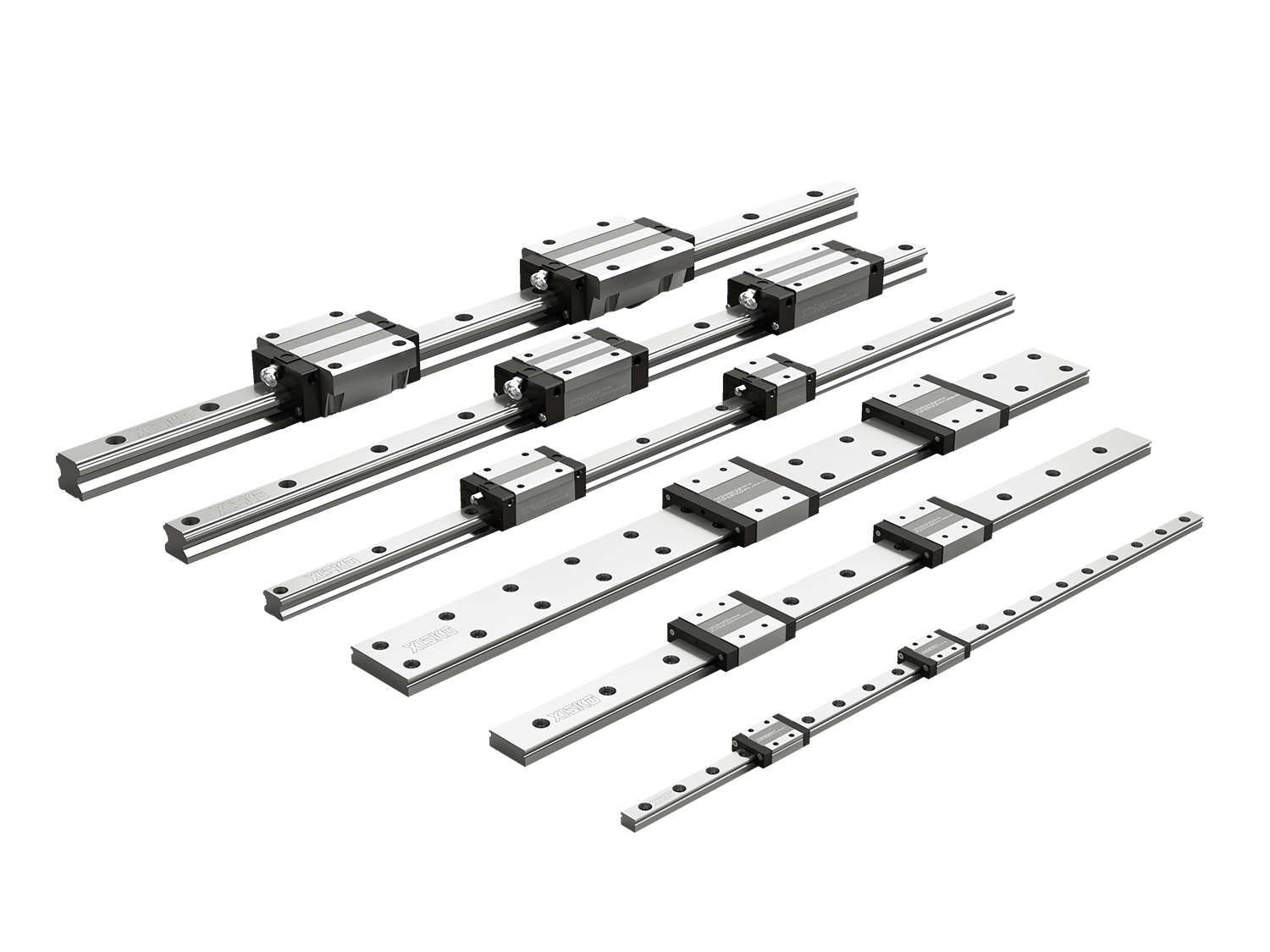

Linear guides are generally classified into interchangeable and non-interchangeable types based on whether the carriage and rail can be freely combined. While they share similar structures and operating principles, they differ significantly in terms of pairing methods, precision, installation and maintenance, and application scenarios. Understanding these differences helps in selecting the right linear guide for your equipment.
1. What is a Non-Interchangeable Linear Guide?
Non-interchangeable linear guides feature components that are not universal; their dimensions and shapes vary. Simkawa’s non-interchangeable designs allow for customization based on specific space and load capacity requirements.
This design is typically suited for applications demanding high load capacity and rigidity, though the components cannot be swapped between different pieces of equipment.
2. What is an Interchangeable Linear Guide?
Interchangeable linear guides feature components with standardized dimensions and shapes, allowing them to be swapped between different pieces of equipment for greater flexibility.
Simkawa’s interchangeable designs are suitable for a wide range of equipment because they maintain consistent component dimensions and shapes. However, compared to non-interchangeable designs, interchangeable guides generally offer lower load capacity and slightly less rigidity.
3. Key Differences Between Interchangeable and Non-Interchangeable
| Comparison Item | Interchangeable Linear Guide | Non-interchangeable Linear Guide |
| Pairing Method | Blocks and rails of the same specifications can be combined | Blocks and rails are supplied as matched sets |
| Ordering Method | Carriages and rails can be ordered separately | Typically ordered as a complete set |
| Ease of Replacement | Individual replacement is more convenient | Replacing the entire set or re-pairing is recommended |
| Precision Level | Suitable for general and high-precision applications | Better suited for ultra-precision applications |
| Preload Consistency | Controlled by standardized tolerance ranges | Stricter control achieved through matching |
| Procurement Costs | Usually lower | Usually higher |
| Typical Applications | Automation equipment, packaging machinery, general-purpose machine tools | Precision machine tools, measuring equipment, semiconductor equipment |
4. How to Choose the Right Linear Guide?
When selecting Simkawa linear guides, first consider your specific needs, such as required load capacity and rigidity.
Choose a non-interchangeable design if high load capacity and rigidity are priorities; choose an interchangeable design if flexibility and versatility are more important. Additionally, consider factors such as the service life of the equipment and components, as well as the operating environment.
5. Points to Consider During Selection
5.1 Do Not Rely Solely on Interface Dimensions
Even if linear guides from different brands share similar specifications, heights, and mounting hole spacings, their internal raceway designs, rated loads, preload levels, and precision standards may differ. Always verify the complete technical specifications before attempting to replace a guide with one from a different brand.
5.2 Confirm Precision and Preload Grades
Matching model numbers does not guarantee that components can be directly combined. When ordering replacement carriages, you must also confirm the precision grade, preload grade, sealing structure, and lubrication method.
5.3 Consider Long-term Maintenance Costs
Non-interchangeable guide rails offer a distinct advantage in initial precision, but replacement and inventory management can be more complex. For production equipment requiring frequent maintenance, interchangeable guide rails may result in lower long-term operating costs.
5.4 Select Based on Actual Requirements
If the equipment does not require ultra-high precision, opting for high-grade non-interchangeable guide rails could lead to unnecessary procurement and maintenance expenses. Proper selection should be based on factors such as load, speed, precision, rigidity, and the operating environment.
Summary
The non-interchangeable and interchangeable options for Simkawa linear guide rails are designed to meet different needs. When making a selection, it is important to consider your specific requirements and the actual application conditions to achieve the best results.