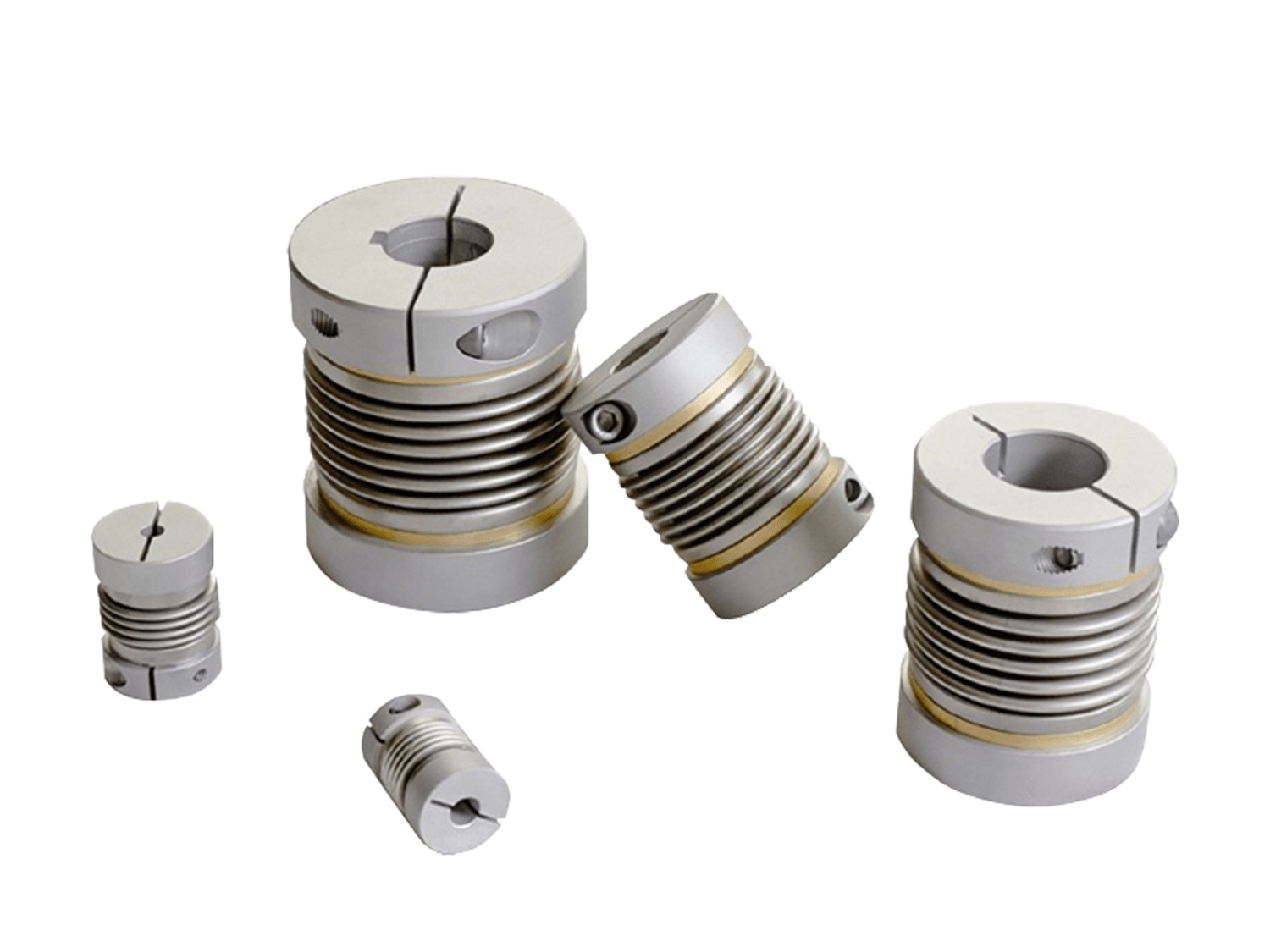

A coupling is a mechanical component used to connect two shafts (a driving shaft and a driven shaft) from different mechanisms, enabling them to rotate together and transmit torque. In high-speed, heavy-load power transmission applications, certain couplings also serve to provide cushioning, dampen vibration, and enhance the dynamic performance of the shaft system. This article focuses on the disc flexible coupling; as a type of flexible coupling utilizing elastic elements, its dedicated discussion here highlights its significance.
1. Structural Composition of Disc Flexible Couplings
The disc flexible coupling is a type of metallic flexible coupling that transmits torque using a flexible metallic diaphragm as the elastic element. Its key features include high torque transmission capacity, the ability to accommodate misalignment through diaphragm deformation, and the absence of relative motion between components—resulting in no wear, no noise, effective vibration damping, a long service life, and no need for lubrication. Torsional stiffness and critical speed can be adjusted by modifying the outer diameter or wall thickness of the intermediate spacer, thereby improving the torsional vibration characteristics of the machinery unit.
A disc flexible coupling consists of at least one diaphragm and two hubs. The diaphragm is typically fastened to the hubs with pins, ensuring a secure connection that prevents loosening or backlash between the diaphragm and the hubs. Some manufacturers offer designs featuring two or three diaphragms, incorporating one or two rigid intermediate elements connected to the hubs on either side. The primary difference between single-diaphragm and double-diaphragm couplings lies in their capacity to accommodate various types of misalignment; because the diaphragm must undergo complex bending, single-diaphragm couplings are less suitable for handling parallel misalignment (offset). In contrast, double-diaphragm couplings can bend in different directions simultaneously, allowing them to compensate for parallel misalignment.
2. Key Characteristics of Disc Flexible Couplings
- Strong capability to compensate for shaft misalignment: compared to gear couplings, they can accommodate twice the angular misalignment, generate lower reaction forces during radial displacement, offer high flexibility, and tolerate specific degrees of axial, radial, and angular displacement.
- Significant vibration damping effect; operates without noise or wear.
- Suitable for operation in high-temperature environments (-80°C to +300°C) and harsh conditions, maintaining safe performance under shock and vibration loads.
- High transmission efficiency, reaching up to 99.86%. It is particularly suitable for medium-to-high-speed, high-power transmission applications.
- Simple structure, lightweight, compact size, and easy installation/disassembly. It allows for installation and removal without moving the connected machinery (specifically for spacer-type models) and requires no lubrication.
- Capable of accurate speed transmission with zero slip, making it suitable for precision machinery drives.
Current manufacturing capabilities for disc flexible couplings allow for power transmission up to 50,000 kW, rotational speeds up to 80,000 rpm, and lengths up to 12 meters. Furthermore, diaphragm couplings can undergo various types of modifications.

3. Applications of Diaphragm Couplings
Disc flexible couplings are widely used in the shaft transmission systems of various mechanical devices, such as pumps (especially high-power and chemical pumps), fans, compressors, hydraulic machinery, petroleum equipment, printing machinery, textile machinery, chemical processing equipment, mining machinery, metallurgical equipment, aviation (helicopters), high-speed marine power transmission systems, steam turbines, reciprocating power machinery drives, tracked vehicles, and high-speed, high-power generator sets. Their use in high-speed transmission shafting—following dynamic balancing—is increasingly common.
4. Causes of Abnormal Noise in Disc Flexible Couplings
- Excessive spacing between the two coupling halves subjects the diaphragm to significant axial force, leading to wear on the reamed holes or fitted bolts, which results in abnormal noise;
- Excessive axial misalignment or angular deflection between the two coupling halves can cause vibration and abnormal noise during equipment operation;
- Speed discrepancies between the driving and driven ends can also cause vibration and abnormal noise during operation;
- Malfunction of the motor's speed encoder causes fluctuating motor speeds, leading to abnormal noise from the diaphragm coupling.
Summary
The disc flexible coupling is a type of coupling well-suited for high-precision transmission. It offers advantages such as zero backlash, high torsional rigidity, rapid response, maintenance-free operation, and the ability to compensate for installation misalignments. It is widely used in servo motors, stepper motors, ball screws, linear modules, automation equipment, CNC machinery, and inspection equipment.