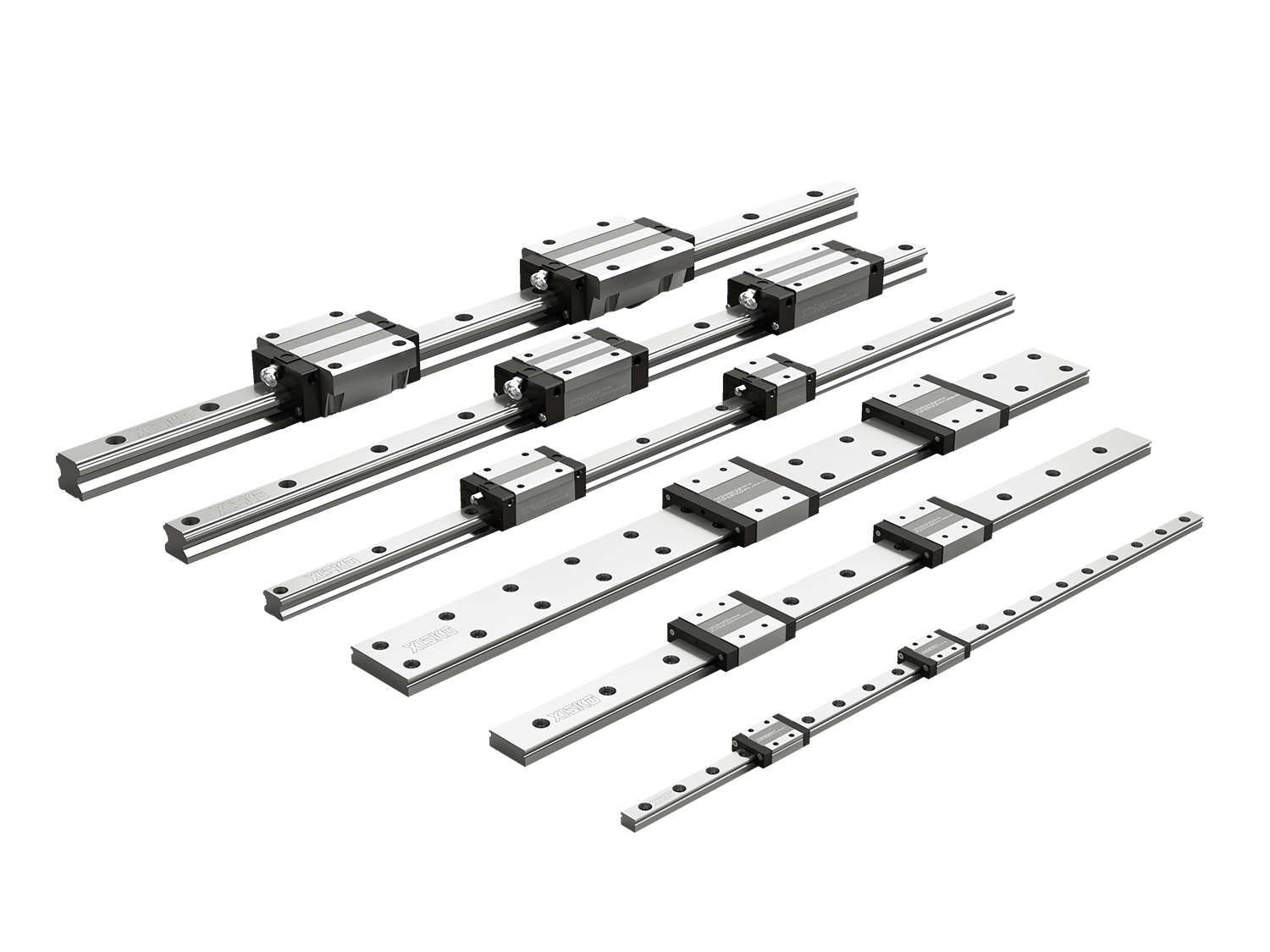

LM rails are frequently used in non-standard machinery. However, to fully utilize the performance of linear guides, the key lies in the correct positioning method. Are you familiar with the four positioning methods for linear guides?
1. Pin Positioning
Lateral positioning of the guide is achieved by inserting a cylindrical pin into the positioning hole of the mounting base. Two positioning pins are used, aligned at two points, allowing for floating adjustment via dynamic testing.
Application Scenarios: Generally used in lighter load structures and applications where high precision is not required.
2. Stepped Positioning
The guide is mounted against the positioning step surface on the side marked with an arrow, ensuring the straightness and planar accuracy of the guide.
Application Scenarios: This is commonly used. It achieves high installation accuracy.
3. Slotted Positioning
The LM rails are positioned with slots on both sides. The slot structure distributes the load.
Application Scenarios: Suitable for heavy loads, offering better precision, and applicable to heavy-duty or high-speed structures.
4. Shim Positioning
In applications with limited mounting surface area, screws and shims are used for positioning to ensure installation accuracy.
Application Scenarios: Suitable for applications with limited installation space but requiring high precision, and applicable to light loads or low speeds.
Conclusion
The positioning method of LM rails directly affects the performance of precision motion systems. By employing appropriate pin positioning, stepped positioning, and elastic preload methods, repeatability, motion smoothness, and system reliability can be effectively improved.