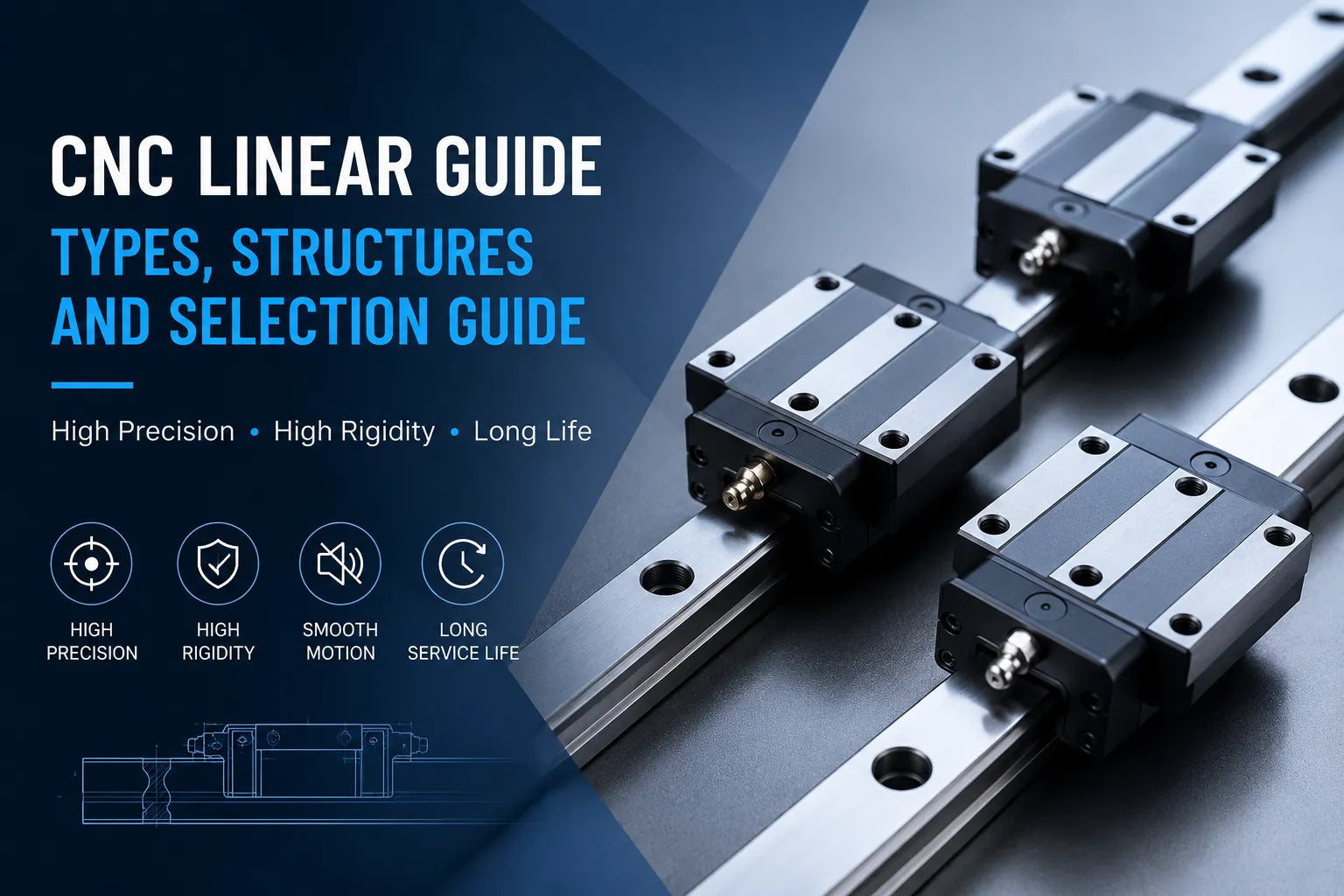

Linear guide selection, seemingly a simple matter of choosing a model, is actually a complete process of assessing operating conditions. This article will systematically explain a more suitable steel guide rails selection approach for non-standard equipment, covering operating parameters, stress calculations, safety factors, lifespan verification, specification selection, and common selection pitfalls. It will help you avoid the risks of selecting based solely on model number or weight.
1. Why are Steel Guide Railss Easily "Selected Incorrectly"?
The three biggest pitfalls in selecting linear guides for non-standard equipment are: focusing only on workpiece weight, ignoring torque, and failing to verify lifespan. What seems "sufficient" actually leaves risks for trial operation and after-sales service.
In short: Larger linear steel guide rails are not necessarily better; the key is "stress matching + sufficient lifespan + proper installation."
Selection overview: First, parameters; then stress; finally, verification; and lastly, specifications.
2. Before Selection, Lock in These 4 Basic Parameters
2.1 Load Parameters
The total moving mass M must include tooling, workpiece, slider, mounting plate, etc. Many people only calculate the workpiece weight, which is already a mistake.
2.2 Motion Parameters
Effective stroke, operating speed, maximum acceleration, start/stop frequency, and number of reciprocations determine the dynamic load, not just the static load.
2.3 Installation Structure
Horizontal/vertical installation, single/double rail, single/multiple sliders, slider spacing, and load eccentricity all directly affect the torque.
2.4 Accuracy and Environment
Ordinary positioning, precision positioning, or ultra-precision positioning? Is there dust, oil mist, water vapor, or corrosive environment? This determines the accuracy level and protection scheme.
2.5 Force Decomposition
Static load, dynamic load, and torque load—none can be omitted.
3. Force Calculation: The Core is the Maximum Value of a Single Slider
- Static Load: G = M × 9.8. Suitable for equipment with long static times and few start/stop cycles.
- Dynamic Load: F = M × a + Ff. This value is crucial for high-speed and high-frequency equipment; friction and inertia must be calculated.
- Torque Load: In eccentric, cantilever, and vertical installations, the overturning moment is often larger than expected and cannot be ignored.
In non-standard equipment, don't select based on "average distribution." The selection must be based on the single-slider force under the most unfavorable operating conditions.
4. Safety Factor and Lifespan: How to Choose Without Wasting Resources
4.1 Static Safety Factor Fs
Used to check the resistance to deformation when stationary. Different safety factors correspond to general operating conditions, eccentric operating conditions, and impact operating conditions; it's not a one-size-fits-all number.
Recommendation: For ordinary stable operating conditions, a reference value of 1.0~1.5 is suitable; for eccentric/cantilevered conditions, it can be appropriately increased.
4.2 Dynamic Safety Factor S
Used to check the service life. The requirements differ for low-speed, conventional, and medium-to-high-speed continuous operating conditions.
Recommendation: For continuous reciprocating and high-frequency start-stop operations, don't just look at the rated value; the service life in hours is more important.
5. How to Define Specifications for Effective Implementation
5.1 Guide Rail Length
Total length = Effective stroke + Slider length + Safety margin at both ends. For high-speed equipment or equipment with protective covers, the safety margin should be increased further.
5.2 Slider Types
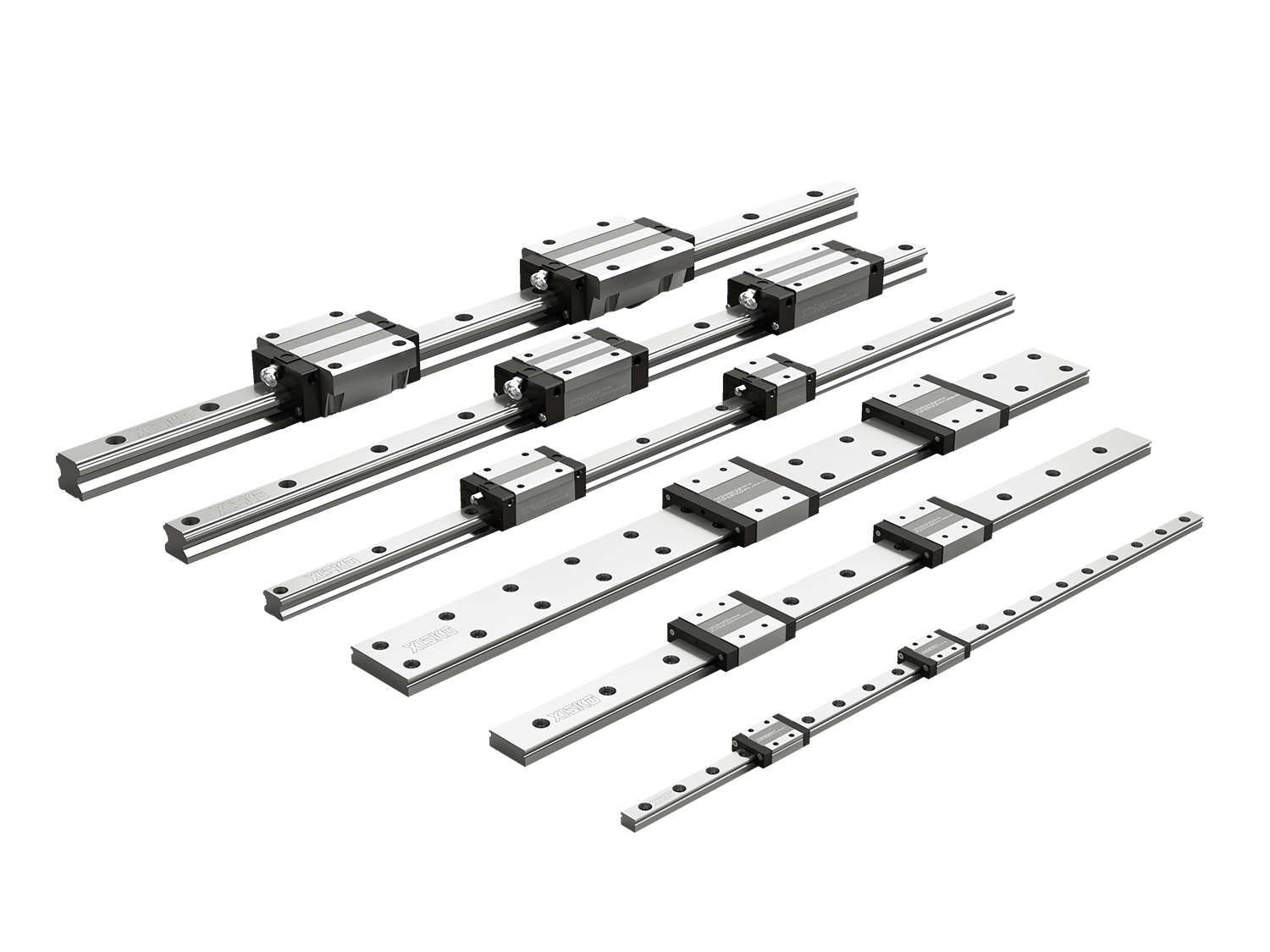
Flanged sliders are suitable for applications requiring high load-bearing capacity and installation stability; square sliders save vertical space; extended sliders are suitable for applications with high torque and anti-tipping requirements.
5.3 Precision Grades
Grade C is suitable for conveying and handling; Grade H is suitable for most non-standard equipment; P/SP/UP are more commonly used for high-precision machining and inspection.
5.4 Preload Grades
C0: Light load, low speed; C1: Light vibration positioning; C2: Heavy load, high rigidity. Tighter isn't always better; excessive tightness will sacrifice lifespan and smoothness.
Selection Process: First consider the working condition, then the load, and finally check the safety factor and lifespan.
6. 6 High-Frequency Pitfalls (Recommended to Save)
- Calculating Only Workpiece Weight
The mounting plate, tooling, and slider body are not included in the calculation, resulting in an underestimated load.
- Ignoring Torque Loads
For eccentric, cantilever, and vertical installations, the risk is not in the weight itself.
- Low Speed Doesn't Count Dynamic Loads
Low speed does not mean no impact; start-stop inertia will accumulate fatigue.
- Blindly upgrading precision and preload by one level
Many general-purpose devices only increase costs, not improve usability.
- Insufficient guide rail length margin
Sufficient stroke does not guarantee safety; end margins must also be calculated.
- Selecting multi-slider models based on average values
The real key is to consider the stress on a single slider at the most unfavorable position.
6.1 How to Avoid This?
- Determine operating boundaries first, then calculate the forces acting on the individual slider.
- Verify service life first, then determine the size specifications.
- Confirm mounting rigidity first, then address high-precision requirements.
Engineering Judgment Criteria
If it can be calculated, do not rely on guesswork based on experience; if it can be converted into hours of service, do not look solely at nominal ratings; if verification can be performed against the worst-case operating conditions, do not use average values.
7. Case Study: How to Select Guide Rails for a Horizontal Transport Slide
The following demonstration uses a common non-standard transport shaft. To make the calculation closer to real equipment, an eccentric load is added to the case study, avoiding the shortcut of "average distribution."
| Operating Parameters | Values | Descriptions |
| Structure | Horizontal installation, dual guide rails with four sliders | 2 sliders per guide rail |
| Total moving mass M | 120 kg | Includes workpiece, fixture, mounting plate, and slider seat. |
| Effective stroke | 600 mm | Medium-speed reciprocating conveying |
| Maximum acceleration a | 1.2 m/s2 | Frequent starts and stops |
| Average operating speed v | 24 m/min | Used for lifespan calculation |
| Load eccentricity e | 120 mm | Load center of gravity deviates from the center line of the dual guide rails |
| Center distance of dual guide rails B | 160 mm | Used for estimating the additional load caused by overturning moment |
 Schematic diagram of the case study operating conditions
A horizontal double-rail, four-block conveyor, 120kg total mass, medium-speed reciprocating motion, with eccentric load. How should the steel guide rails be selected for this conveyor slide in this case study?
7.1 Calculation in This Order
- Static Load: G=120 x 9.8=1176 N, approximately 294N per block on average.
- Eccentric Moment: Mo= 1176 x 0.12= 141.1 N-m, equivalent to an additional load of approximately 882 N.
- Most Unfavorable Block: Two blocks on one side share the load, additional load approximately 441N, maximum static load per block approximately 735N.
- Dynamic Load: Fa=120 x 1.2+11.8=155.8N, approximately 39N distributed across the four blocks.
- Equivalent Dynamic Load: P = 735 + 39 = 774N.
7.2 Verification Conclusion
- Static Safety Factor: Fs=2.0; C0 2 735 x 2.0 = 1470N
- Dynamic Safety Factor: S=1.8; C≥ 774x 1.8 = 1393 N
- Guide Rail Length: 600 + 60 + 80 x 2 = 820 mm (Estimated Total Length)
- Lifespan (in hours): Estimated based on C=8000N sample, H=76400h, sufficient for conventional equipment.
7.3 Case Conclusion
For this operating condition, it is recommended to start with the 15/20 series dual-rail four-slider sample. Accuracy can be initially assessed at H grade, preload at C1, and the total guide rail length should be 850~900mm, then confirmed in conjunction with the installation space.
Summary
The core of linear steel guide rail selection is not simply mapping the load weight to a specific model, but rather clearly understanding the stress state of the equipment during actual operation. In short, a reliable linear guide rail selection process should be: first confirm the operating condition boundaries, then calculate the stress; first check the safety factor and lifespan, then determine the guide rail specifications; first ensure installation rigidity, then consider higher accuracy and preload levels.