
When selecting CNC linear rails, many people tend to focus solely on dimensions or price, overlooking factors such as guide type, carriage structure, and load direction. This article examines various aspects of CNC linear guides to help users make informed choices regarding the linear guides and carriages best suited to their equipment.
1. Classification of Linear Guide Body (Slide Rail)
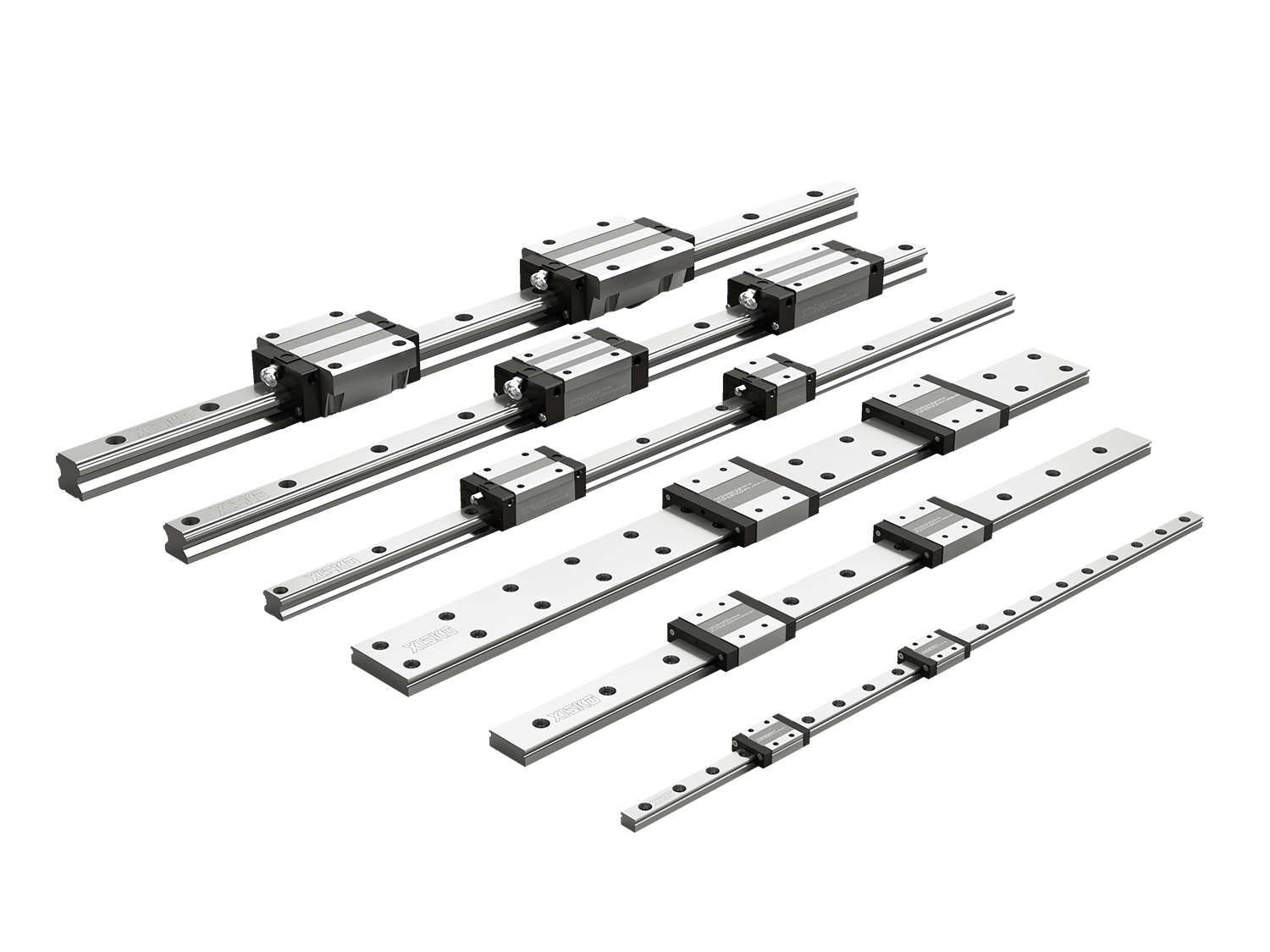
1.1 Classification by Rolling Element (Core Differentiation)
(1) Ball CNC Linear Rail (Steel Ball Point Contact)
- Advantages: Low coefficient of friction, high speed and quiet operation, moderate price, complete specifications
- Disadvantages: Average load capacity and rigidity, poor impact resistance
- Applications: Automation, engraving machines, loading and unloading, testing equipment, small and medium-sized CNC machines
- Main specifications: 15/20/25/30/35/45/55/65
(2) Roller Linear Guide (Cylindrical Roller Line Contact)
- Advantages: Rated load capacity and rigidity are 30%~80% higher than ball linear guides, resistant to heavy cutting and impact
- Disadvantages: Greater weight, higher cost, higher operating noise Slightly larger
- Applicable to: Gantry machine tools, machining centers, stamping, heavy-duty cutting machines, large gantry modules
- Specifications: 35/45/55/65/85/100
(3) Miniature ball bearing guides
- 7/9/12/15 narrow guides, ultra-thin and compact, mostly stainless steel
- Applicable to: precision instruments, semiconductors, small testing slides, miniature robotic arms
(4) Special guides
- Stainless steel guides: rust-proof, suitable for food, medical, water mist, and weakly corrosive environments
- Chrome plated guides: ordinary rust-proof, suitable for cutting fluid applications
- Spliced long guides: stroke > 2m segmented splicing, with matching docking positioning pins
1.2 By Precision Grade (General Standard)
- From Low to High: C (Ordinary) → H (Advanced) → P (Precision) → SP (Ultra-Precision) → UP (Ultra-High Precision)
- C/H: Conveyor lines, simple blanking, ordinary frames, no high precision requirements
- P: Engraving machines, CNC equipment, automated handling (most commonly used in the industry)
- SP/UP: Coordinate measuring machines, optical inspection, grinding machines, semiconductor equipment preload level (slide rail + slider matching preload, eliminating gaps)
- C0 Zero Preload: No preload, minimal resistance, light load, low speed manual mechanism
- C1 Micro Preload: General automation, balancing smoothness and rigidity (standard preferred)
- C2 Medium Preload: High-speed reciprocating, light cutting, anti-vibration
- C3 Heavy Preload: Heavy cutting, vertical lifting, high impact, gantry equipment
2. Complete Slider Classification (Four Mainstream Structures on the Market)
Slider model corresponds to slide rail width. The same rail width has four different structures with completely different installation dimensions:
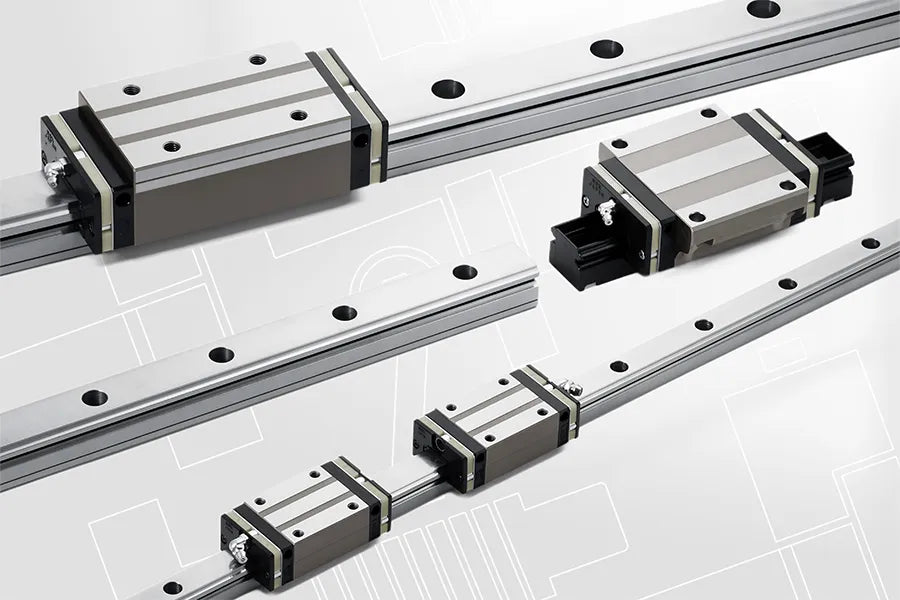
2.1 High-assembly square slider HGH / SHS (Square Standard Block)
- Appearance: Overall square shape, tall, screws lock the slider body from top to bottom.
- Advantages: Strong vertical and lateral rigidity, anti-tipping, preferred for vertical hoisting.
- Disadvantages: Large overall installation height.
- Applications: Machine tools, engraving and milling machines, heavy-duty vertical slides.
2.2 Low-profile flange slider EGH / SSR (Short side flange)
- Appearance: Low slider, flanges on both sides, screws lock the flanges from the base plate upwards.
- Advantages: Small overall height, saves equipment space, most common for automation.
- Disadvantages: Lateral rigidity is slightly lower than high-profile square sliders.
Applications: 3C automation, production lines, small modules.
2.3 Wide flange slider QZ / RGW (Wide version)
Increased slider width, wider rolling column spacing, significantly improved lateral load capacity.
- Applications: Unilateral load, cantilever structure, mechanisms with large unilateral force.
2.4 Miniature slider LGN / LGW
Ultra-thin and extremely small, available in miniature square (LGN) and miniature flange (LGW) versions, mostly stainless steel.

- Applications: Miniature slides, camera fine-tuning, small inspection equipment.
Additional Slider Categories (Environmental Accessories)
- Standard Dustproof Slider: Built-in dustproof scraper, suitable for dry cleanrooms.
- Double-layer Dustproof/Extended Scraper Slider: For woodworking, stoneworking, and grinding processes with high dust levels.
- Oil-sealed Slider: With end caps and sealing rings, prevents cutting fluid and oil/water intrusion.
- Stainless Steel Slider: All-metal rust-resistant, suitable for humid and corrosive environments.
- High-Temperature Resistant Slider: Matched with high-temperature grease, suitable for ovens and heat treatment equipment.
3. Complete Selection Steps for CNC Linear Rail + Slider Combinations
3.1 Review Basic Operating Parameters
1. Installation Method: Horizontal Placement / Vertical Suspension / Inclined Cantilever
2. Load: Self-weight, workpiece load, acceleration dynamic load, whether off-center loading/impact
3. Motion parameters: Maximum speed, acceleration, daily reciprocating strokes, total stroke
4. Environment: Dust, cutting fluid, water vapor, corrosion, temperature
5. Accuracy requirements: Repeatability, straightness
3.2 Determine ball or roller
Small to medium load, high speed, quiet operation, automated equipment → Ball guide
Over 200kg, heavy cutting, frequent impact, large gantry → Roller guide
Miniature small space, precision small mechanism → Miniature stainless steel guide
3.3 Select slider structure (core dimension trade-offs)
Equipment height limited, horizontal installation: Low-assembly flange EGH
Vertical lifting, large lateral force, machine tool equipment: High-assembly square slider HGH
Cantilever with unilateral force, severe off-center loading: Widened flange slider
Small and micro-mechanisms: MGN/MGW miniature slider
3.4 Load calculation, select guide width
Life core formula: Equivalent dynamic load Peq → Rated life L10 = (C/Peq)³ × 50km
C = Rated dynamic load of the slider (sample parameter, the larger the rail width, the larger C)
Empirical quick selection reference (single guide rail, 2 sliders, horizontal uniform speed, no impact)
- <5kg: 7/9/12 micro;
- 5-50kg: 15/20/25;
- 50-150kg: 30/35;
- 150-400kg: 45/55 ball bearing or 35/45 roller guides;
- >400kg heavy load: 55/65/85 roller guides.
Key reminder: For vertical installation, high acceleration, cantilever off-center loading, the specification must be one size larger.
3.5 Match the preload level
- Manual light load, low speed smoothness preferred: C0;
- Universal for most automated equipment: C1 (default selection);
- High-speed reciprocating, light cutting, vibration resistance: C2;
- Heavy cutting, gantry cranes, heavy lifting, strong impact: C3.
3.6 Select the accuracy level
Ordinary conveyor → C/H; Automated CNC → P; Optical Precision Equipment → SP/UP.
3.7 Optional Dustproof and Rustproof Accessories
- High Dust (Woodworking/Stone): Double-layer dustproof + scraper slider;
- Machine Tool Cutting Fluid: Oil-sealed slider + chrome-plated slide rail;
- Moisture-Constrained/Corrosive Food and Medical Equipment: Stainless Steel Complete Guide Rail and Slider Set.
3.8 Slider Quantity and Guide Rail Length Configuration
- Standard Layout: Two guide rails, each with 2 sliders, best stability, anti-tipping;
- Short Stroke Small Slide Table: Single guide rail with 2 sliders;
- Long Stroke, Heavy Load, Cantilever: Each guide rail ≥ 3 sliders;
- Total Guide Rail Length = Effective Stroke + Allowance at both ends (50~100mm on each side).
4. Key Points for CNC Linear Rail Selection and Avoidance
Vertical mechanisms only consider static weight, ignoring acceleration inertial loads; undersized guide rails are prone to wear and failure. Cantilevered single-sided loads do not require widened sliders; long-term unilateral force will cause gaps and jamming. In dusty environments, omitting double-layer dust protection allows steel balls to enter, shortening guide rail life by 80%. Using C3 heavy preload in high-speed conditions results in high frictional heat generation and increased noise. Long CNC linear rails (>2 meters) without splicing and positioning can cause uneven installation surfaces, leading to jamming and abnormal noise. Weightless Blindly selecting roller guides for impact applications significantly increases costs and results in low cost-effectiveness.
5. Typical Complete Set Selection Cases
- 3C Handling Module: 25 low-assembly EGH ball slide, C1 preload, P-grade precision
- CNC Milling Machine: 30 high-assembly HGH ball slide, C2 preload
- Gantry Machining Center: 45 roller RGW widened slide, C3 preload, P-grade
- Camera Precision Inspection Slide: 12MGW miniature stainless steel slide, C0 preload, SP precision
- Stone Carving Heavy-Duty Gantry: 65 roller slide, double-layer dustproof and chip-removing complete set of components