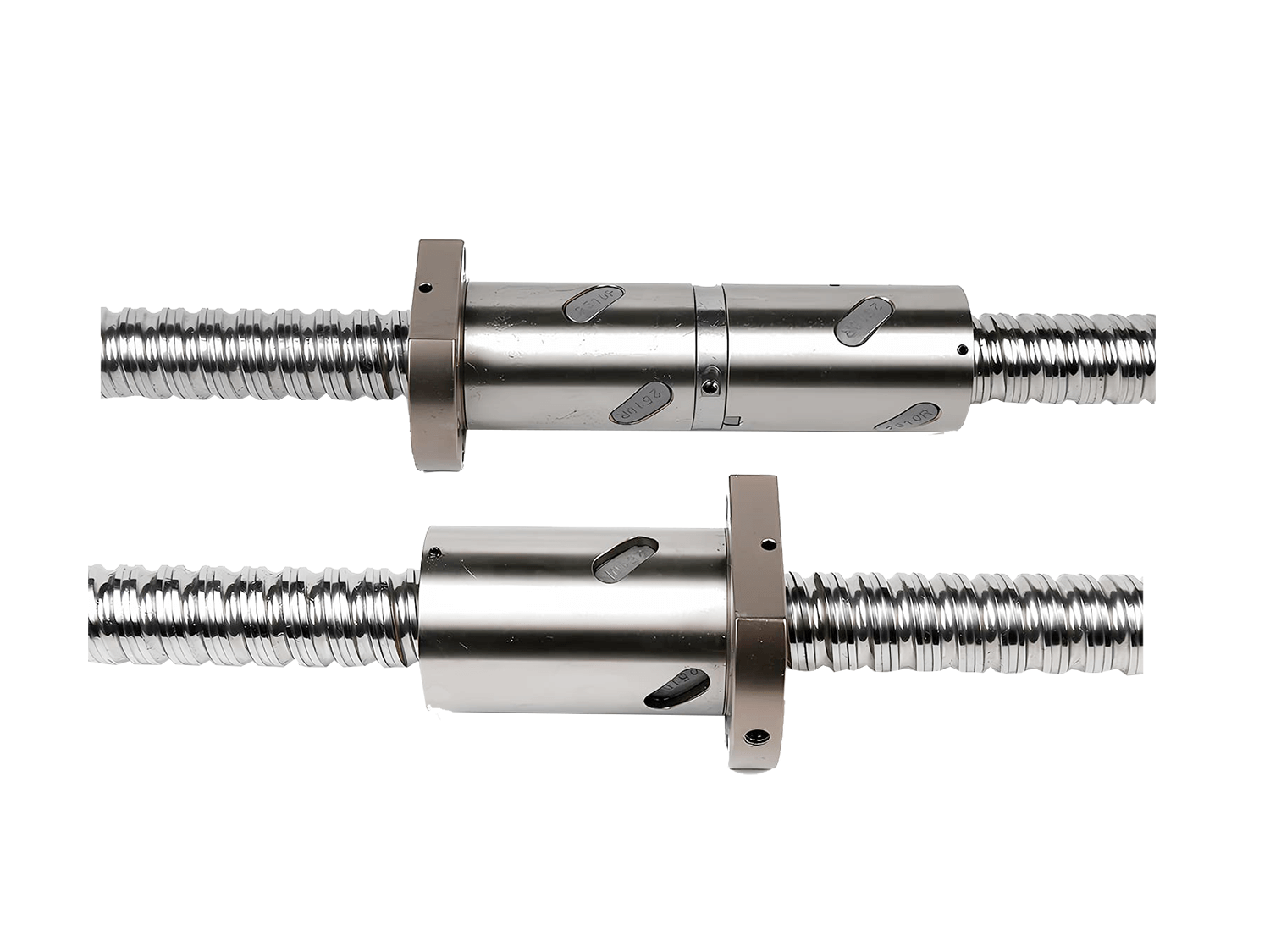

Ball screws are widely used in CNC machine tools, industrial automation, precision positioning systems, and linear motion equipment. However, selecting the right ball screw is only part of the design process. The way the screw shaft is supported at both ends also plays an important role in determining system rigidity, critical speed, positioning stability, and service life.
There are four common ball screw support arrangements: Fixed-Fixed, Fixed-Supported, Fixed-Free, and Supported-Supported. Each configuration provides a different combination of axial restraint and radial support, making it suitable for different operating conditions.
Understanding these four ball screw support types helps engineers select an appropriate bearing arrangement based on screw length, rotational speed, axial load, positioning accuracy, and thermal expansion requirements.
What Are Ball Screw Support Types?
Ball screw support types describe how the two ends of a ball screw shaft are supported and restrained by bearings.
The support arrangement determines whether the screw shaft can move axially, how effectively it resists bending, and how stable it remains during high-speed operation.
Before comparing the four configurations, it is important to understand the difference between a fixed end and a supported end.
Fixed End vs. Supported End
Fixed End
A fixed end provides both radial and axial support. It establishes the axial reference position of the screw shaft and carries axial loads generated during operation.
A typical fixed-end support unit uses a preloaded angular contact bearing arrangement to improve axial rigidity and reduce unwanted movement.
Supported End
A supported end primarily provides radial support while allowing the screw shaft to move axially when necessary. This arrangement helps accommodate thermal expansion and reduces unnecessary axial restraint.
A deep-groove ball bearing is commonly used in a supported-side unit.
The two support units therefore perform different functions and should not be treated as interchangeable components.
1. Fixed-Fixed Support
Fixed-Fixed means that both ends of the ball screw shaft are supported by fixed bearing arrangements. Both ends provide radial and axial restraint.
This configuration provides the highest overall support rigidity and generally offers the greatest critical-speed potential among the four arrangements.
Main Characteristics
-
High axial rigidity and positioning stability.
-
Strong resistance to shaft deflection.
-
High critical-speed potential.
-
Suitable for demanding precision and high-speed applications.
-
Requires accurate installation alignment and thermal expansion management.
Since both ends are axially restrained, temperature changes can generate additional internal forces in the screw shaft and bearings. Proper bearing preload, shaft pretension, and thermal compensation must therefore be considered during the design process.
Typical Applications
-
High-precision CNC machining centers.
-
High-speed machine tool feed axes.
-
Precision positioning platforms.
-
Industrial equipment requiring high structural rigidity.
Best suited for: Applications where high rigidity, positioning stability, and rotational speed are major priorities.
2. Fixed-Supported Support
Fixed-Supported uses one fixed bearing arrangement at one end and one supported bearing arrangement at the opposite end.
The fixed end establishes the axial reference and carries axial loads, while the supported end provides radial stability and allows axial movement to accommodate thermal expansion.
This configuration offers a practical balance between rigidity, installation complexity, and thermal compensation.
Main Characteristics
-
Good axial positioning stability.
-
Effective radial support at both ends.
-
Allows axial thermal expansion at the supported end.
-
Lower installation complexity than a fully fixed arrangement.
-
Balanced rigidity and operating stability.
Fixed-Supported is one of the most widely used arrangements for general industrial ball screw systems. It is commonly selected for applications requiring medium-to-high operating speeds and positioning accuracy.
Typical Applications
-
CNC machine tools.
-
Industrial automation equipment.
-
Linear positioning modules.
-
General-purpose machinery.
-
Automated production systems.
Best suited for: Applications requiring a balance of positioning accuracy, operating speed, rigidity, and thermal expansion compensation.
3. Fixed-Free Support
Fixed-Free means that one end of the ball screw shaft is secured by a fixed bearing arrangement, while the opposite end remains unsupported.
The fixed end establishes the axial position and supports the shaft. The free end has no additional bearing support.
This is a relatively simple and economical configuration, but it provides the lowest support rigidity and critical-speed potential among the four arrangements.
Main Characteristics
-
Simple mechanical structure.
-
Lower bearing and installation costs.
-
Allows axial growth toward the free end.
-
Greater susceptibility to shaft deflection and vibration.
-
Limited critical speed and load capacity compared with arrangements that support both ends.
Because the free end lacks radial support, shaft length and rotational speed must be carefully evaluated. A long, slender screw operating at high speed may experience excessive vibration or shaft whipping.
Typical Applications
-
Short-stroke positioning mechanisms.
-
Compact automation equipment.
-
Low-speed transmission systems.
-
Light-load linear motion mechanisms.
Best suited for: Short screw shafts with relatively low rotational speeds and light operating loads.
4. Supported-Supported Support
Supported-Supported uses radial support at both ends of the ball screw shaft, while neither end provides the same axial locating function as a fixed bearing arrangement.
Both ends help maintain radial stability and reduce shaft deflection, but the bearings alone do not establish a defined axial reference position.
An additional axial locating or positioning arrangement may therefore be necessary, depending on the application.
Main Characteristics
-
Radial support at both ends.
-
Allows axial movement at both support ends.
-
Better shaft stability than a fixed-free arrangement.
-
Lower axial locating capability than fixed-supported or fixed-fixed configurations.
-
Requires careful consideration of axial positioning and thrust-load transmission.
This arrangement is more suitable for systems where the screw does not need to provide precise axial positioning through its end bearings, or where another mechanical structure establishes the axial reference.
Typical Applications
-
Auxiliary transmission mechanisms.
-
Low-precision linear motion systems.
-
Non-positioning transmission equipment.
-
Applications with an independent axial locating arrangement.
Best suited for: Applications where radial shaft support is needed but the end bearings are not responsible for precise axial positioning.
Comparison of the Four Ball Screw Support Types
Choosing the correct ball screw support arrangement requires understanding the differences in bearing restraint, rigidity, thermal expansion, and operating conditions.
| Comparison | Fixed-Fixed | Fixed-Supported | Fixed-Free | Supported-Supported |
|---|---|---|---|---|
| End support | Fixed / Fixed | Fixed / Supported | Fixed / Free | Supported / Supported |
| Axial restraint | Both ends | One end | One end | Neither end |
| Radial support | Both ends | Both ends | One end | Both ends |
| Support rigidity | Highest | High | Lowest | Moderate |
| Critical-speed potential | Highest | High | Lowest | Moderate |
| Thermal expansion | Requires design control | Accommodated at supported end | Accommodated toward free end | Axial movement at both ends |
| Installation complexity | High | Moderate | Low | Moderate |
| Typical application | Precision CNC | General automation | Short, low-speed axes | Auxiliary mechanisms |
Note: The rigidity and critical-speed rankings are relative comparisons under equivalent screw geometry and support-span conditions. Actual performance must be calculated using the selected screw and bearing specifications.
How to Choose the Right Ball Screw Support Arrangement?
The best ball screw support arrangement depends on the actual operating conditions rather than the support configuration alone.
Engineers should consider the following five factors before making a selection.
1. Required Positioning Accuracy
For applications requiring high positioning accuracy and axial rigidity, Fixed-Fixed or Fixed-Supported arrangements are generally more appropriate.
Fixed-Fixed provides stronger axial restraint at both ends, while Fixed-Supported offers a practical balance between positioning stability and thermal compensation.
2. Rotational Speed and Critical Speed
Critical speed is the rotational speed at which the ball screw shaft approaches its natural bending frequency, potentially causing resonance, vibration, and unstable operation.
The support arrangement directly influences this limit.
For the same screw geometry and support span, the general critical-speed ranking is:
Fixed-Fixed > Fixed-Supported > Supported-Supported > Fixed-Free.
However, the actual allowable speed also depends on the screw's root diameter, unsupported length, bearing specifications, and ball nut design.
The ball screw's DN limit and bearing speed rating must also be checked. A commonly used engineering guideline is to keep the operating speed below approximately 80% of the calculated critical speed, subject to the manufacturer's specifications.
3. Axial Load and Operating Direction
The ball screw must withstand the axial forces generated by acceleration, deceleration, and external working loads.
For applications involving significant axial loads or frequent changes in load direction, the fixed-end bearing arrangement must provide sufficient axial load capacity and rigidity.
Vertical applications also require careful evaluation of the screw's compressive load and buckling resistance.
4. Thermal Expansion
Continuous operation generates heat through bearing friction, lubrication, and mechanical transmission.
As the screw shaft heats up, its length changes.
A Fixed-Supported arrangement allows axial expansion at the supported end, making it a practical solution for many general-purpose applications.
Fixed-Fixed arrangements require a more carefully engineered thermal expansion strategy to prevent excessive internal forces and bearing loads.
5. Installation Space and Mechanical Structure
The available installation space, shaft-end machining, bearing housing dimensions, and motor connection also influence support selection.
Before ordering a ball screw, confirm that the shaft-end geometry matches the selected support units and that both bearing positions can be aligned accurately.
Common Installation Considerations
Even with the correct support arrangement, improper installation can reduce ball screw performance.
The following points should be checked during assembly:
-
Bearing alignment: Ensure that the fixed and supported bearing units are properly aligned with the screw shaft.
-
Bearing preload: Use the specified preload for fixed-end bearing assemblies. Excessive preload can increase friction and operating temperature.
-
Axial movement: Make sure the supported end can move axially as designed.
-
Shaft runout: Check shaft runout and axial clearance during installation.
-
Thermal compensation: Verify that the design accommodates the expected temperature variation.
-
Lubrication: Use the appropriate lubricant and maintenance schedule for the ball screw and bearing units.
Correct installation helps reduce vibration, unnecessary friction, positioning errors, and premature bearing wear.
How Does SIMKAWA Support Different Ball Screw Applications?
SIMKAWA provides a range of ball screw transmission products for CNC machinery, industrial automation, precision positioning, and other linear motion applications.
Its product portfolio includes:
-
FSC Miniature Ball Screw: Compact construction for precision equipment with limited installation space.
-
FFNI Preloaded Ball Screw: Double-nut preload structure designed to reduce axial clearance and improve rigidity.
-
FDC Double Nut Ball Screw: Designed for applications requiring high axial load capacity and rigidity.
-
DFA Servo Ball Screw: A ball screw solution for servo-driven transmission systems.
-
DFU CNC Ball Screw: Designed for CNC machine tool applications.
Different ball screw models may require different shaft-end machining and bearing configurations. Therefore, the appropriate support arrangement should be confirmed according to the screw specifications and actual operating conditions.
Explore SIMKAWA's Ball Screw Product Collection to find a suitable transmission solution.
For technical assistance or customized requirements, contact SIMKAWA with your screw diameter, lead, shaft length, operating speed, axial load, and installation requirements.
Conclusion
Ball screw support arrangements have a direct influence on system rigidity, critical speed, thermal behavior, and positioning stability.
-
Fixed-Fixed: Maximum support rigidity and critical-speed potential.
-
Fixed-Supported: A balanced solution for general CNC and automation applications.
-
Fixed-Free: A simple configuration for short, low-speed, and light-load systems.
-
Supported-Supported: Radial support at both ends for applications with independent axial positioning.
Selecting the right arrangement requires evaluating the complete mechanical system, including screw dimensions, axial load, rotational speed, bearing specifications, and thermal conditions.
With the appropriate ball screw and bearing configuration, manufacturers can achieve more stable transmission, reliable positioning, and longer equipment service life.
Frequently Asked Questions (FAQ)
1. Which ball screw support arrangement provides the highest rigidity?
Fixed-Fixed generally provides the highest support rigidity and critical-speed potential because both ends of the screw shaft are rigidly restrained. It is suitable for precision and high-speed applications when thermal expansion and installation alignment are properly managed.
2. Which ball screw support arrangement is most commonly used?
Fixed-Supported is a widely used general-purpose arrangement. It combines axial positioning at the fixed end with radial support and thermal expansion accommodation at the supported end.
3. What is the difference between Fixed-Fixed and Fixed-Supported?
Fixed-Fixed restrains the screw shaft axially at both ends, providing higher rigidity but requiring thermal expansion management.
Fixed-Supported restrains the shaft at one end while allowing axial movement at the other, offering a practical balance between rigidity and thermal compensation.
4. Does ball screw support affect critical speed?
Yes. The bearing arrangement changes the shaft's boundary conditions and therefore its bending behavior and critical speed. Fixed-Fixed generally provides the highest critical-speed potential, while Fixed-Free provides the lowest.
5. Can a Fixed-Free ball screw be used for high-speed applications?
Generally, Fixed-Free is not recommended for long, high-speed screw shafts because the unsupported end increases the risk of bending vibration and shaft instability. It is more appropriate for short, low-speed applications.
6. Is ball screw support configuration the same as ball nut preload?
No. Support configuration describes how the screw shaft is supported at its ends. Ball nut preload describes how internal clearance between the balls and raceways is controlled.
They are two different design parameters, and both must be considered when selecting a ball screw system.